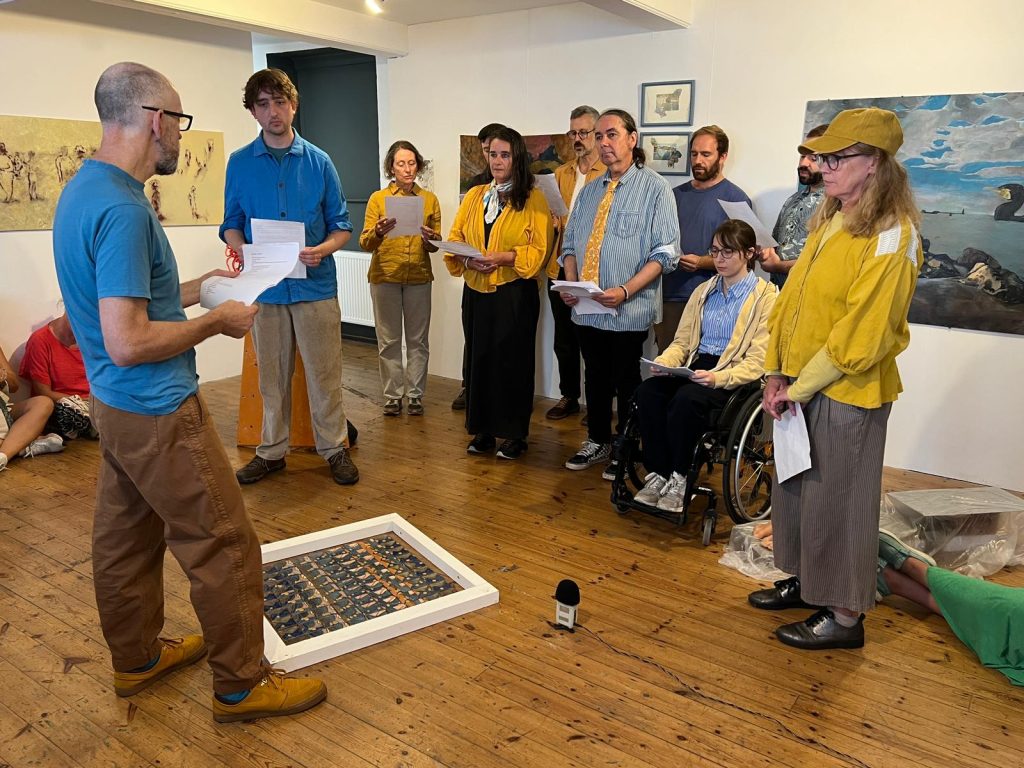
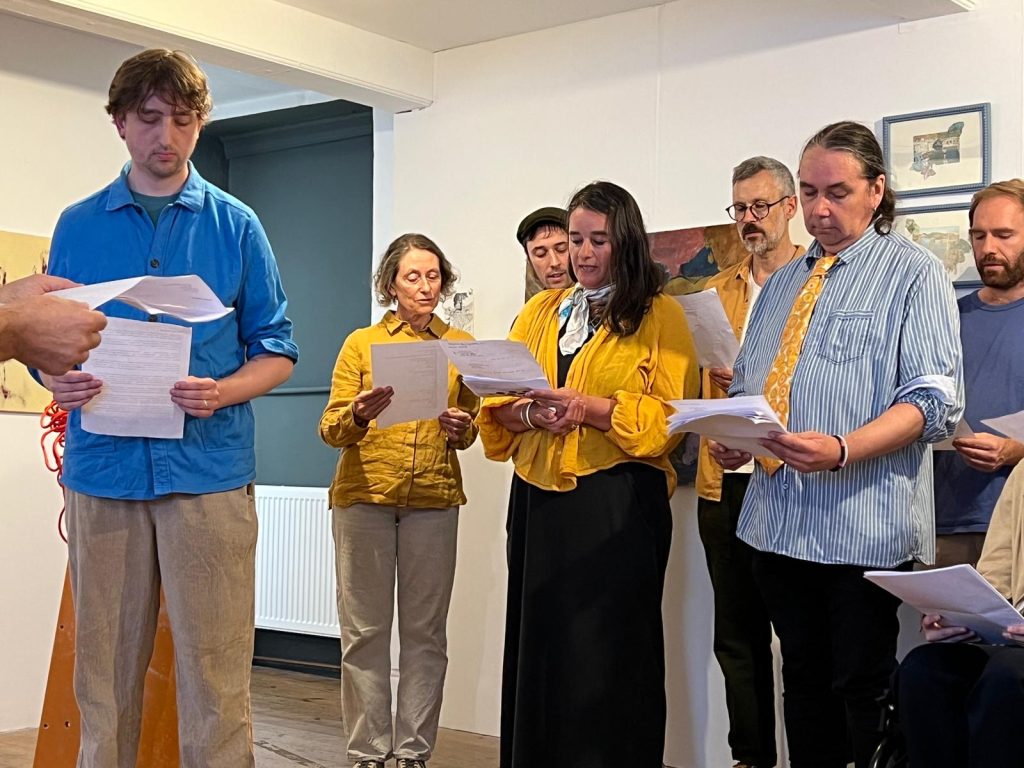
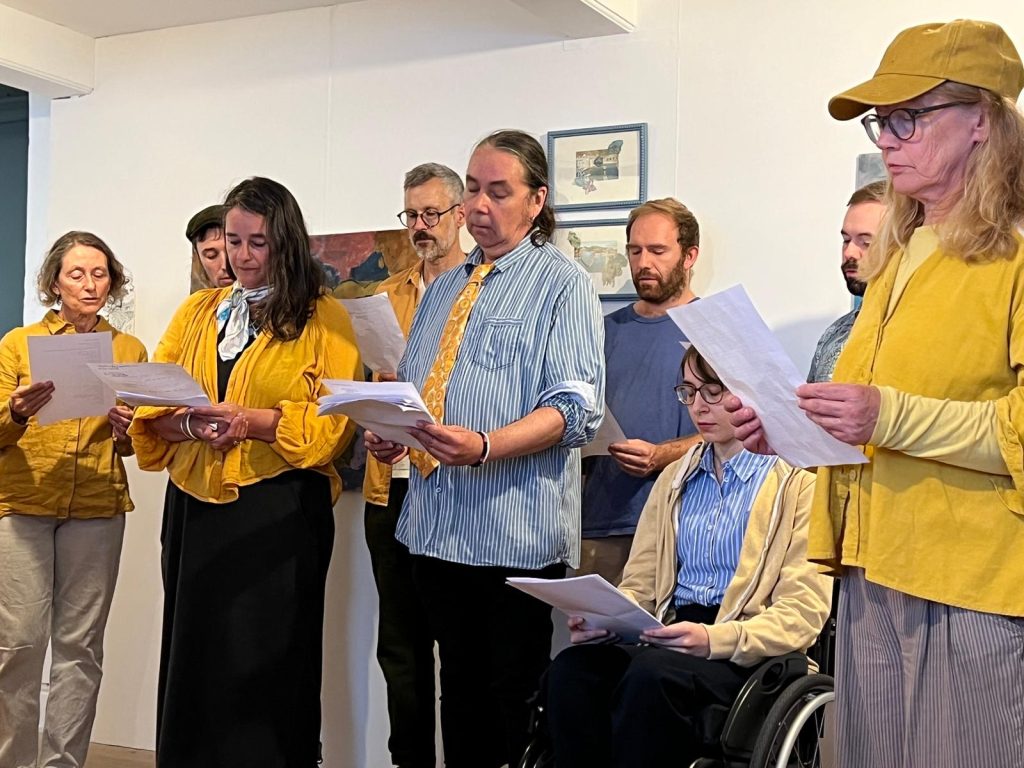
On Thursday 27th August at 1800hrs I presented a live version of Swim Litany in the gallery at 37 Looe Street as part of the Bathing Places exhibition. Following a very short introduction, a group of 10 readers performing as a ‘speech choir’ gave a rehearsed reading of the text in three parts.
Rachael Allain, Paul Beaumont, Mo Bottomley, Benjamin Brake, Elena Brake, Katrina Brown, Charlie Cornforth, Rosanna Irvine, Sam Machell, and Matti Spence
Thanks to Angela Piccini and Sefryn Penrose of 37 Looe Street for hosting us.
Swim Litany is a visual text and spoken word score published as an A3 poster. One side presents a range of information sourced from diary records of my swims from mid-summer 2025 to mid-summer 2026. This data includes references to place, to bodies of water, to those I swam with. On the other side textual material is organised into three areas, each section having a different character, with the potential for performance by one, three, or more voices.
Swimming is something that I do, it is part of my life, and I fit it around other things – weather, work, travel, health. Senses of rhythm, of repetition, of the social activity of swimming are evident in the printed poster and in performance. Interruptions to the rhythm and variations in the text record the impact of the rest of life on my swimming, while the writing acknowledges my appreciation of access to safe water and my physical ability to swim regularly.
For a live event on August 27th, a group of performers will read from the text, their voices mixing, blending, bumping against each other as they navigate the three sections. Rhythm, repetition, overlap and silence will depend on the character of the sections, and the speakers’ responses to the words and to each other.
Performance: 1800hrs (6.00pm) on Thursday 27th August 2026 at 37 Looe Street, Plymouth, PL4 0DQ as part of the Bathing Places exhibition.
My review of Lives of the Voice: An Essay on Closeness by Hans Ulrich Gumbrecht is now live on the Leonardo Reviews site.
The book set me thinking about my father’s voice, remembering a mixture of emotions, of expectation and resistance. My father was a farmer, but also a singer, singing at weddings and funerals, at home and to his cows. Known locally as a singer, his reputation generated a mix of embarrassment and pride in me as a child and created expectations that I too might be a singer. Listening to other singers, I sometimes catch echoes of his voice and am drawn into a spatial-temporal relationship of nearness and distance, of connections among material human bodies and the specific sounds they produce. The bittersweet sensation that Gumbrecht highlights as specific to singing and listening to songs (p. 51-52) is wrapped up in a sense of being overwhelmed by some experiences of song, and a paradoxical sensation of proximity with voices of the dead or of artists we have never seen live.
Shelley Hodgson and I are making a radio show for Soundart Radio’s First Spark Festival 2025. For broadcast on Sunday 2nd February starting at 12 noon, the programme will mix recordings, conversation and songs. Playing with ideas of names and naming as a point of beginning, connecting to First Spark’s occurence at Imbolc, a new year, a new beginning, we will look at naming ceremonies, giving names and changing names, and the idea of naming a year. The mix will include references to the film Morvern Callar, the novel 4,3,2,1 by Paul Auster, Ali Smith’s latest novel Gliff, and we will play songs with references to names and beginnings. 105.2fm
My review of Sonic Faction: Audio Essay as Medium and Method is now live at Leonardo Reviews. The review will be included in print in Leonardo 58.2 (due for publication in February 2025).
Sonic Faction was a pair of events, one held at Iklectik in London (July 2022) and one at KARST in Plymouth (February 2023), where three works were presented for collective listening, along with a public discussion and an installation of related material. The three pieces were: Mark Fisher and Justin Barton’s On Vanishing Land (2006), Steve Goodman’s Astro-Darien (2021) and Robin Mackay’s By the North Sea (2022). This book takes on several tasks, operating as a catalogue for or record of the events, offering an expanded commentary on the works presented and giving significant detail on the conception, making and presentation of these. The book also functions as a primer or a means toward defining or describing a genre – the audio essay – situating it in historic, artistic, critical, theoretical contexts. In pursuit of this, the book brings together a selection of essays that describe or demonstrate the audio essay as a medium and as an approach to making art. Bringing together writing by artists, theorists, publishers, broadcasters the mix of perspectives and modes of involvement with the audio essay results in an array of textual riches, supplemented by a comprehensive playlist on YouTube.